
A dust extractor for concrete is not just a cleanup accessory. On drilling, grinding and cutting work, it is part of the control system that keeps respirable silica from becoming an airborne jobsite problem.
That makes the buying decision more technical than comparing tank size or picking the vacuum with the biggest CFM number. The extractor has to work with the tool, shroud, hose and duty cycle. Crews choosing drilling equipment can start with this hammer drill vs rotary hammer guide, because the dust-control setup should follow the actual concrete task.
Concrete Dust Control Starts Before the Vacuum Turns On
Concrete dust control begins with the way the work is planned, not with the extractor sitting beside the tool. Cutting, drilling and grinding all release fine particles differently, so the control method needs to be selected around the specific task, attachment and work area before production starts.
A powerful extractor can still underperform if the shroud does not sit correctly against the surface or if the hose connection leaks. Small setup problems can allow dust to escape at the point of generation, which is exactly where the system is supposed to contain it.
Crews should also think about how long the tool will run and how quickly the application loads the filter. Short anchor-hole drilling may place relatively light demand on a collection system, while continuous grinding can fill bags and coat filters quickly enough to reduce suction during the shift.
That makes system planning as important as extractor size. Before comparing CFM, tank capacity or HEPA ratings, contractors should identify the tool, accessory, dust volume and duration of use. Those factors determine what the extractor actually needs to do once the work begins.
A Dust Extractor for Concrete Has to Match the Tool
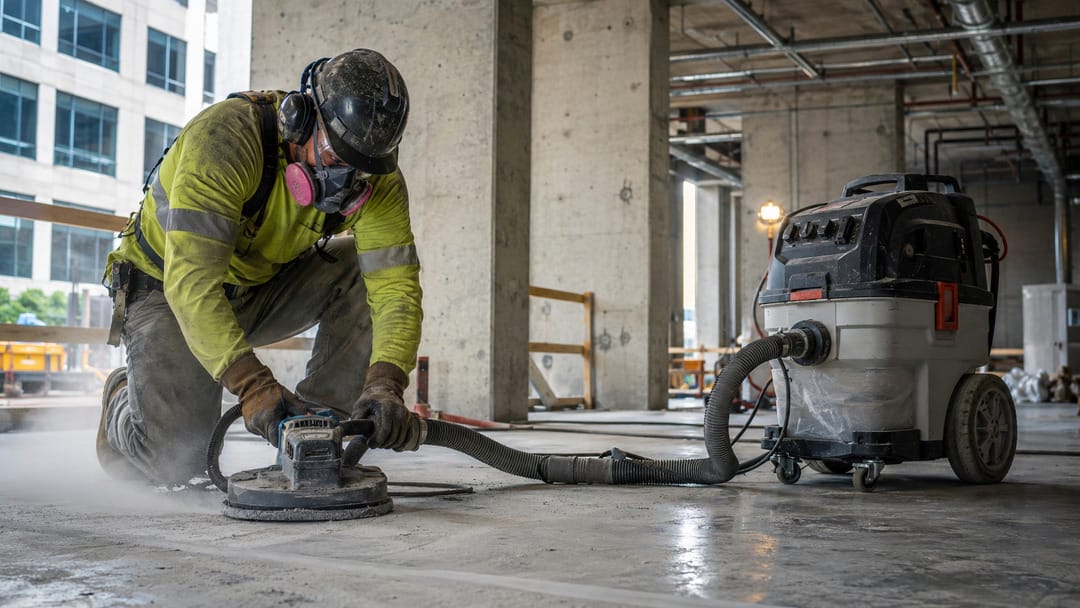
Concrete drilling, surface grinding and cutting can all generate respirable crystalline silica, but they do not place the same demand on an extractor. A rotary hammer making anchor holes creates a different dust stream from a 7-inch grinder removing coatings across a slab.
That is why capture at the source matters more than buying a vacuum in isolation. A well-matched shroud or cowling surrounds the point where dust is created and gives the extractor a defined path for pulling material away before it spreads.
Start with the tool and accessory the extractor will serve most often. A compact unit may suit drilling and intermittent chipping. Sustained grinding, especially with larger wheels or floor-preparation equipment, can demand more airflow, dust capacity and filter-management capability.
CFM Is a Minimum, Not a Performance Guarantee
CFM measures airflow, but the number on the housing does not tell the whole story. Hose length, diameter, bends, clogged filters, full bags and restrictive fittings can reduce the airflow available at the shroud.
OSHA’s construction silica rule makes airflow task-specific. Under Table 1, handheld grinders using a dust collection system for mortar removal or other covered grinding work require at least 25 CFM per inch of wheel diameter, plus the specified filtration and filter-cleaning or pre-separation provisions. A 5-inch wheel therefore corresponds to 125 CFM, while a 7-inch wheel corresponds to 175 CFM under that control method.
The practical lesson is to shop for usable airflow, not merely the biggest advertised number. Check the tool manufacturer’s instructions, extractor rating and complete hose-and-shroud combination before assuming a system is suitable.
Here is a simple way to frame the selection:
| Concrete task | Main dust-control hardware | Airflow or filtration consideration | Buying priority |
|---|---|---|---|
| Anchor-hole drilling | Drill shroud or integrated collector | Meet tool-maker airflow guidance; filtration and filter cleaning matter | Portability and tight capture |
| Hand grinding | Full wheel shroud and extractor | Table 1 can require 25 CFM per inch of wheel diameter | Sustained airflow and filter cleaning |
| Tuckpointing | Grinder shroud and extractor | High dust loading; task-specific respiratory requirements may also apply | Strong capture and pre-separation |
| Walk-behind floor grinding | Machine dust port and recommended extractor | Follow grinder manufacturer airflow requirements | Capacity, continuous performance and disposal |
| Concrete cutting | Tool-specific wet or dry control | Control method depends on saw type and work conditions | Correct system for the specific saw |
The table shows why a single extractor is not automatically ideal for every concrete tool in a crew’s inventory.
HEPA Filtration Does Not Fix a Weak Collection System
HEPA is valuable, but it is often treated as a shortcut for evaluating the whole machine. OSHA defines a HEPA filter as at least 99.97% efficient at removing monodispersed particles 0.3 micrometers in diameter. That describes filtration performance; it does not guarantee that dust reaches the filter.
A leaking shroud, poor hose connection or weak airflow can let silica-containing dust escape before filtration becomes relevant. A filter packed with fine concrete dust can also reduce suction unless the extractor can clean it effectively.
For frequent concrete work, filter maintenance deserves nearly as much attention as the filter specification. Automatic or pulse cleaning, or an effective cyclonic pre-separator, can reduce loading and preserve airflow during longer grinding sessions. Bag design matters too because careless disposal can put captured dust back into the air.
Shrouds and Hoses Can Make a Good Extractor Perform Badly
The extractor, hose and shroud should be treated as one system. A high-output machine connected through an undersized, overly long or sharply bent hose can lose performance where it matters most: at the wheel or bit.
NIOSH local exhaust ventilation testing on handheld concrete grinders found that the tested grinder-and-shroud combinations reduced dust exposure by at least 90%. The useful takeaway is that effective local capture can make a major difference when the components are properly matched.
Look for a shroud designed for the tool diameter and application, secure connections and a hose arrangement that does not kink or pull the guard away from the work. System compatibility is not a glamorous specification, but it often determines whether the setup stays effective through a full shift.
The Buying Signals That Matter Beyond the Spec Sheet
Concrete dust is hard on filters, so the better long-term extractor is often the one that holds performance as the collector fills. Favor manufacturers that provide clear airflow requirements, approved shroud combinations, filter-cleaning instructions and silica-control documentation instead of vague “dust ready” language.
Also separate drilling needs from production grinding. An integrated HEPA attachment on a rotary hammer can be convenient for repetitive anchor holes, while a large grinder may need a dedicated extractor with higher airflow, larger collection capacity and pre-separation.
Indoor work raises the stakes because escaped dust can remain in the work area and migrate into adjacent spaces. OSHA Table 1 also includes task- and duration-specific respiratory requirements for some operations, so an extractor should not be treated as permission to ignore the rest of the control plan.
A professional purchase should ultimately follow one principle: the task controls the choice. Wheel or bit size, required airflow, filter efficiency, cleaning mechanism, hose layout, shroud fit, capacity and disposal method belong in the same decision.
Choosing the right dust extractor for concrete is less about buying the most expensive vacuum than building a control system that keeps capturing dust under load. If airflow collapses, the shroud leaks or the filter blinds over, impressive specifications on paper do not protect the crew or keep the job moving.
Frequently asked questions
Does a dust extractor for concrete need a HEPA filter?
Not every OSHA Table 1 task specifies HEPA filtration, but HEPA filtration is valuable for controlling fine dust. Contractors should follow the exact requirements for their task and the equipment manufacturer’s instructions.
How much CFM does a 5-inch concrete grinder need?
For applicable handheld grinding under OSHA Table 1 using a dust collection system, the requirement is at least 25 CFM per inch of wheel diameter. A 5-inch wheel therefore calls for at least 125 CFM.
Can I use a regular shop vacuum for concrete grinding?
A shop vacuum should not be assumed suitable simply because it has strong advertised airflow. The complete system must satisfy applicable filtration, airflow, filter-cleaning, shroud and other requirements for the concrete task being performed.
Is automatic filter cleaning worth having?
For repeated grinding and other high-dust work, filter cleaning can help maintain airflow as fine concrete dust accumulates. It also reduces the need to stop frequently and manually service a loaded filter.
Is wet cutting better than using a dust extractor?
Neither method is universally better. OSHA Table 1 specifies different wet and dust-collection controls depending on the tool and task. Use the control method permitted for the specific operation and work environment.