
A construction camera used to answer a narrow question: what happened on the site? AI jobsite intelligence is pushing it toward a much more useful one: what is happening now that deserves a superintendent’s attention?
That change puts cameras in the same operational conversation as laser measures, trackers and connected power tools. The common thread across professional jobsite tools is no longer simply that they collect information or perform a task. Increasingly, their value depends on how quickly physical activity becomes usable data for the person running the project.
Construction Cameras Are Moving Into the Daily Workflow
For superintendents, the biggest limitation of a traditional jobsite camera is not image quality. It is the amount of interpretation still required afterward. A camera may record every delivery, crew movement and equipment change, but that footage has limited operational value if someone must manually review hours of video to find one useful event.
That is why the next generation of construction cameras is being judged less like security equipment and more like field instrumentation. The value comes from turning observation into usable signals—flagging activity, organizing visual records and helping site leaders identify changes without constantly scanning every feed.
This shift fits a broader pattern across connected construction technology. Asset trackers report where tools are, telematics systems reveal how equipment is being used, and smart power tools can capture data tied to specific tasks. Cameras are beginning to serve a similar role by translating visual activity across a much larger area of the project.
For superintendents managing multiple crews, deliveries and work zones at once, that can change the role of the camera entirely. Instead of functioning mainly as a record of what happened, the system can become part of the daily decision loop—surfacing events that deserve attention before they disappear into a backlog of footage.
AI jobsite intelligence turns cameras into sensors
Traditional construction cameras are good at documentation. They can create time-lapse records, provide remote views and preserve footage for security investigations. The weakness appears after capture: somebody still has to review the images and decide what matters.
AI changes that division of labor. Computer-vision systems can analyze visual information for recognizable people, equipment, movement and site conditions, then surface selected findings rather than presenting another folder of images.
That is the important transition. The camera becomes a sensor, while the software becomes the interpretation layer.
Recent systems are expanding far beyond intrusion alerts. Sensera Systems, for example, added gate monitoring, license-plate capture and material analysis to SiteCloud Insights in July 2026. Its new SiteCloud monitoring features can identify vehicle activity and compare material quantities across daily images, turning fixed cameras into inputs for logistics and scheduling decisions.
A superintendent therefore may not need to watch a gate to know whether a delivery arrived. The useful output is the event itself: the vehicle entered, stayed for a period, and changed the material situation on site.
The physical-tool connection is becoming harder to ignore
Construction technology is often divided into hardware and software, but the distinction becomes less useful when software depends on continuously observing the physical jobsite.
A laser measure converts distance into a number. An asset tracker converts tool movement into location data. A connected impact wrench can record or control aspects of fastening work. An AI camera performs the same broad function at a larger scale: it converts physical conditions into information that can influence the next action.
That makes visual intelligence closer to instrumentation than ordinary surveillance.
The difference becomes clearer when common camera outputs are connected to field decisions:
| Jobsite signal | AI interpretation | Potential superintendent action |
|---|---|---|
| Vehicle enters gate | Delivery or contractor arrival | Adjust staging or sequence |
| Material pile changes | Inventory trend | Check replenishment timing |
| Work area changes | Progress indication | Verify schedule status |
| PPE pattern detected | Possible safety issue | Inspect condition in person |
| Equipment movement | Activity pattern | Review utilization or logistics |
| After-hours movement | Possible security event | Investigate or escalate |
None of these outputs builds the project. Their value comes from reducing the time between a physical change and the management response.
That is physical jobsite data becoming actionable, which is increasingly what separates connected equipment from conventional hardware.
Progress monitoring could change the superintendent’s daily rhythm
Superintendents already collect enormous amounts of information through walks, conversations, photographs and trade updates. The problem is not necessarily a shortage of observations. It is that those observations arrive at different times, in different formats and with different levels of context.
Visual AI can create a more consistent record.
Location-aware systems can go further by connecting imagery to the physical position where it was captured. OpenSpace describes a spatial AI workflow that combines computer vision, location and time so captured imagery can be mapped to a floor plan and compared across visits. Its August 2026 explanation describes applications including progress tracking, as-built verification and design coordination.
The practical gain is not that an algorithm suddenly manages the project. It is that a superintendent can spend less time reconstructing what changed.
Less searching, more verification is the stronger productivity argument. If software can direct attention toward a changed condition, delayed activity or questionable installation, field leadership can concentrate on deciding whether the finding matters and what should happen next.
Safety and security now share the same visual infrastructure
Security cameras traditionally become most valuable after something goes wrong. AI systems attempt to move some of that value earlier by identifying conditions that may require attention while work is still underway.
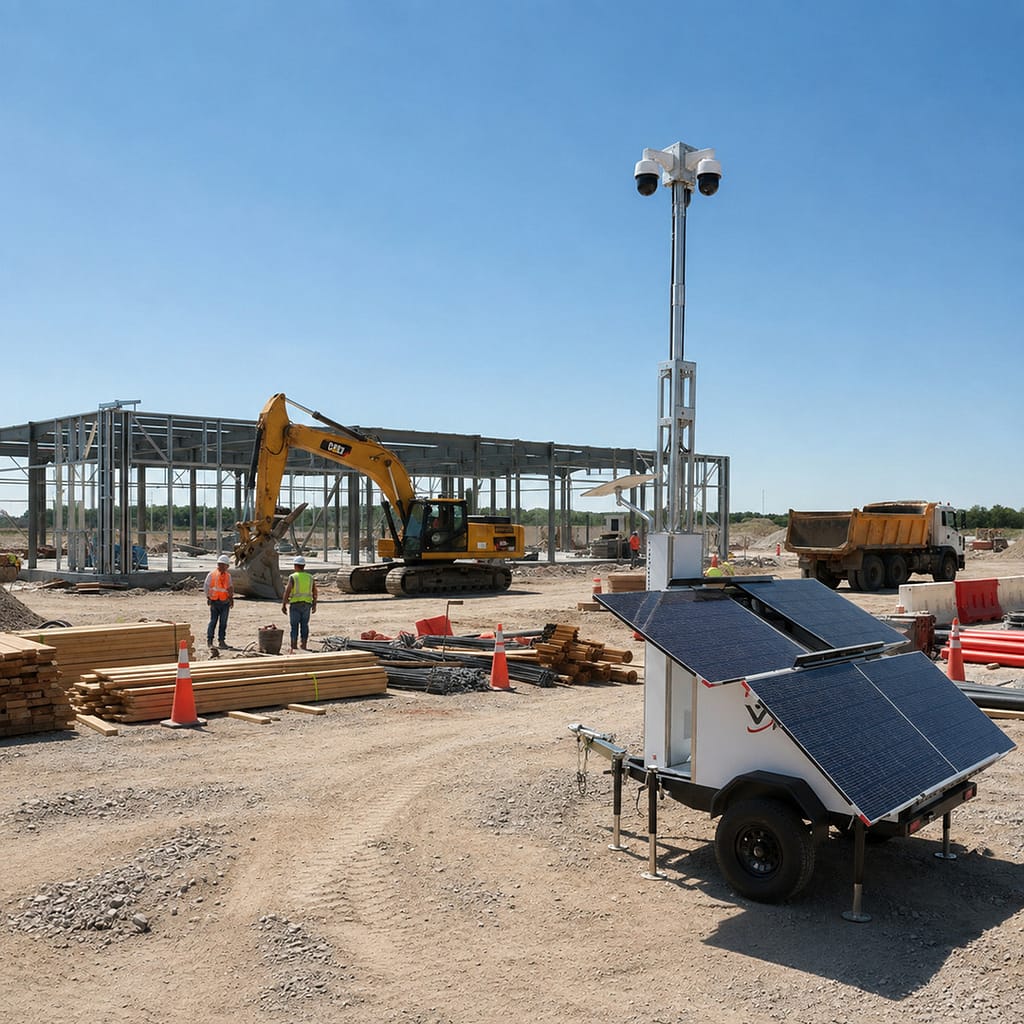
Current construction-camera platforms advertise capabilities such as PPE monitoring, restricted-zone alerts, equipment recognition and activity analysis. Sensera describes automated alerts for potential PPE or restricted-zone issues, while OxBlue says its AI can identify workers, equipment and movement patterns.
That does not make a camera a safety manager.
Construction environments change quickly. Objects block views, PPE can be difficult to distinguish, and a visual model may lack context that an experienced supervisor understands immediately. OxBlue itself states that its AI is not perfect and that results should be verified by a person.
Human verification still matters, particularly when a software alert could affect safety decisions, discipline or compliance documentation.
The useful model is therefore not autonomous supervision. It is a second stream of observations that can help direct a human supervisor toward the places most worth checking.
Accuracy, privacy and alert fatigue could limit the value
Adding intelligence to cameras also creates management problems that ordinary security footage may not create to the same degree.
False positives are an obvious risk. If a system repeatedly flags harmless conditions, crews may begin ignoring notifications. A supposedly intelligent camera that produces too many alerts can simply replace video overload with notification overload.
Privacy deserves equal attention. Systems capable of tracking movement, vehicles, work patterns or PPE create records about what happens on a site. Contractors need clear policies covering who can access that information, how long it is retained and which decisions should never be made from automated interpretation alone.
Integration is another pressure point. A superintendent gains little from an impressive AI dashboard if using it means opening another isolated application that does not connect with scheduling, project management or existing field documentation.
The winning systems will probably be the ones that disappear into normal workflows. Useful intelligence must reach the decision, rather than expecting the superintendent to continually hunt for it.
The next test is whether cameras earn permanent tool status
The strongest signal to watch is how often visual intelligence moves beyond retrospective documentation and into routine field decisions. Gate activity, material tracking, progress verification and searchable visual records already point in that direction.
The harder questions come next: how accurately can these systems interpret messy real-world sites, how effectively do they integrate with project software, and how much time do they actually return to field leadership?
If AI jobsite intelligence clears those tests, the construction camera will become difficult to classify as merely a security device. It will be another piece of jobsite instrumentation—one that continuously measures what people, equipment and materials are doing across a space too large for any superintendent to watch at once.
That is where the technology becomes consequential. The camera does not replace the superintendent’s judgment. It gives that judgment a wider field of view.
Frequently asked questions
What is AI jobsite intelligence?
AI jobsite intelligence uses computer vision and connected software to interpret construction-site imagery and turn it into usable information about progress, equipment, safety, deliveries, security and changing site conditions.
Can AI construction cameras automatically track project progress?
Some platforms can compare visual captures across time or against project information to help identify progress. Their outputs are most useful when they support field verification rather than replace superintendent judgment.
Will AI jobsite cameras replace superintendent walkthroughs?
No. Cameras can extend visibility and help prioritize areas that deserve attention, but physical walkthroughs remain necessary for context, quality checks, trade coordination and conditions that cameras cannot reliably interpret.
How can AI jobsite cameras improve construction safety?
They can help flag possible PPE issues, restricted-area activity or unusual movement patterns. These alerts can direct supervisors toward conditions that need inspection, but they should not be treated as substitutes for human safety oversight.
What are the main risks of using AI jobsite cameras?
The biggest concerns include false alerts, privacy, data retention, limited camera visibility and poor software integration. Their value depends on accurate detection, clear policies and workflows that turn alerts into useful field decisions.