The Milwaukee M18 FUEL STRIKER arrives with a larger target than another place in the cordless tool cabinet. Milwaukee is positioning it as a cordless air hammer replacement for professional service work, pushing battery power into one of the shop jobs that has remained firmly tied to compressed air.
That matters because air hammers are not difficult to understand; they are difficult to untether. A technician can have plenty of striking force at the bench and still lose time dragging a hose around a lift, moving between bays or working on equipment away from the compressor. That pressure point fits a broader move toward professional cordless tools that replace not only cords, but entire support systems.
Milwaukee Is Targeting the Air System, Not Just the Air Hammer
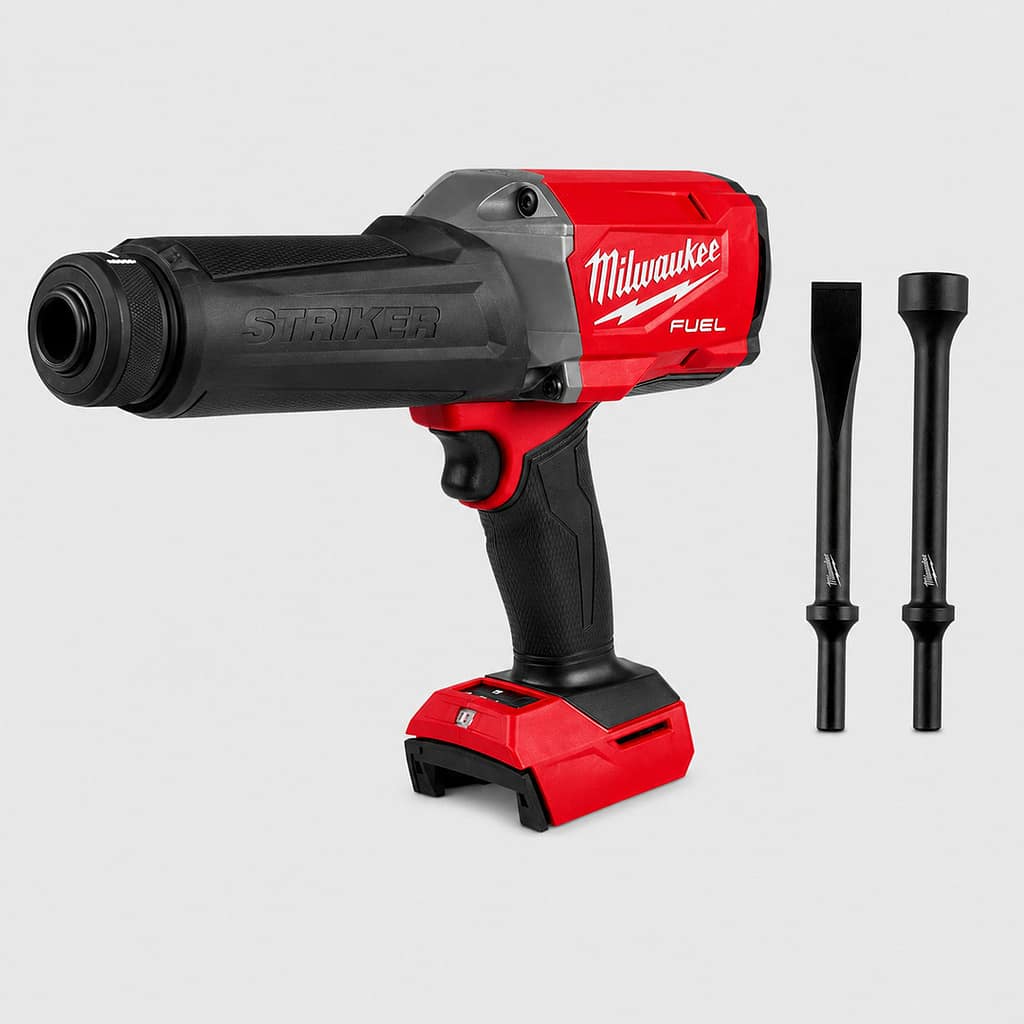
The STRIKER model 3771-20 is built around a POWERSTATE brushless motor and Milwaukee’s M18 battery platform. Milwaukee rates it at 7 joules of striking force and says that output matches leading long-barrel pneumatic hammers operating at 145 PSI. Maximum impact rate is 3,000 blows per minute.
Those numbers give the tool credibility, but the more consequential feature is hose-free mobility. Eliminating the air line means there is no hose to route around a vehicle, no coupler to reconnect after moving bays and no dependence on a compressor when work moves into a parking lot, fleet yard or remote maintenance area.
The official STRIKER specifications show three operating modes: 0–2,500 BPM, 0–3,000 BPM and a ramp-up mode that climbs from zero to 3,000 BPM. A variable-speed trigger lets the technician feather the hit rather than immediately committing to full impact.
Why It Looks Like a Cordless Air Hammer Replacement
Suspension work is where the design makes the strongest case. Ball joints, tie rods, control arms, wheel pins and seized metal components often demand repeated concentrated impacts in spaces where tool positioning is already awkward.
Milwaukee says the STRIKER can separate ball joints at pneumatic speed and claims more than 20 ball-joint separations on an M18 XC5.0 battery in typical suspension work. Runtime will vary with the application, corrosion, accessory and how aggressively the tool is used, so that figure is best treated as a workload benchmark rather than a guaranteed shift length.
The twist-style chuck accepts .401-inch round-shank accessories, which is significant because technicians do not necessarily have to abandon familiar air-hammer bits when moving to cordless. At 7.2 pounds for the bare tool, the STRIKER also remains substantially different in purpose from the larger demolition hammers used for heavy masonry work.
The Real Comparison Is Workflow, Not Joules Alone
A cordless-versus-pneumatic decision cannot be reduced to impact energy. The better question is what happens before, during and after the trigger is pulled.
| Decision factor | M18 FUEL STRIKER | Long-barrel pneumatic air hammer |
|---|---|---|
| Power source | M18 battery | Compressed-air system |
| Mobility | No hose or compressor connection | Limited by hose reach and air access |
| Maximum rated rate | Up to 3,000 BPM | Varies by tool and air supply |
| Impact control | Variable trigger and three modes | Depends on tool design and air setup |
| Accessory interface | .401-inch round shank | Common on many professional air hammers |
| Long-duration use | Requires charged battery capacity | Can run continuously with adequate air supply |
For a mobile technician, fleet mechanic or shop with work spread across multiple locations, the cordless column solves obvious friction. For a fixed bay with a large compressor already feeding multiple pneumatic tools, the equation changes. Existing infrastructure has already been paid for, and a hose may be a minor inconvenience rather than a serious productivity problem.
That distinction is central to the purchase decision: workflow can outweigh raw output once two tools are capable of completing the same core job.
Control Could Matter More Than Maximum Impact
A stubborn suspension part does not always need the hardest possible strike from the first millisecond. On rounded surfaces or near brake, steering and suspension components, getting the bit seated before full impact can matter as much as peak force.
That is where the ramp-up mode has practical value. Gradually building toward 3,000 BPM gives the operator a better chance to establish the contact point before the tool reaches full speed. Combined with a variable trigger, it turns control at startup into part of the performance argument rather than a convenience feature.
The STRIKER should not be confused with a rotary or demolition hammer, however. Milwaukee designed it primarily for separating metal components and vehicle service work. Concrete drilling and sustained heavy masonry removal remain jobs for purpose-built rotary and demolition hammers.
The $599 Tool Is Only Part of the Cost Equation
Milwaukee introduced the bare STRIKER at $599. That can look expensive beside a conventional air hammer viewed in isolation, but the comparison becomes less simple when the compressor, air distribution, fittings, hose maintenance and mobility requirements are included.
A shop that already owns dependable compressed-air infrastructure may have little financial reason to retire every pneumatic hammer. A new service operation, mobile fleet or technician already invested in M18 batteries can see the purchase differently because the battery platform is doing work the air system would otherwise have to support.
That is system-level economics. The better value depends less on which hammer has the lower purchase price and more on which power system the technician is already carrying, maintaining and paying to operate.
Noise also deserves a careful reading. Removing a compressor from the immediate workflow does not prove the striking tool itself is quiet. NIOSH recommends comparing actual equipment noise data when selecting tools through its workplace noise guidance, so hearing-protection decisions should be based on exposure rather than an assumption that battery power automatically means quieter operation.
The Pressure Points That Will Decide Adoption
The first question is whether the STRIKER maintains useful speed on heavily corroded, high-resistance jobs after the novelty of cordless mobility wears off. The second is battery consumption across a full day of mixed suspension and teardown work. The third is real-world durability of the chuck, battery connection and internal striking mechanism under repetitive professional use.
Accessory compatibility lowers the switching barrier, while Milwaukee’s battery-isolation system is designed to reduce pack vibration and maintain a secure connection. Fleet managers and technicians will still judge the tool by uptime, repeatability and how often a job ultimately sends them back to the air hose.
That is the test that matters. Matching a pneumatic specification on paper earns the STRIKER consideration; consistently eliminating setup friction without sacrificing completion speed earns it a permanent place in the shop.
The Air Hammer Is No Longer Untouchable
The strongest case for the Milwaukee M18 FUEL STRIKER is not that pneumatic tools suddenly became obsolete. It is that a job once defined by the compressor now has a credible battery-powered alternative with professional striking force, familiar .401-inch accessories and controls designed around precision service work.
For technicians deciding whether it is a true cordless air hammer replacement, the answer depends on the shop. Pneumatics still make sense where air infrastructure is abundant and continuous duty dominates. In mobile service, multi-bay maintenance and operations trying to reduce dependence on hoses, however, the STRIKER changes the question from “Can cordless do this?” to “How often do we still need air?”
Frequently asked questions
Can the Milwaukee M18 FUEL STRIKER replace every pneumatic air hammer?
Not necessarily. Its specifications target long-barrel pneumatic performance, but shops with established compressed-air systems or unusually long continuous-duty workloads may still find conventional air hammers practical for certain jobs.
What accessories fit the Milwaukee STRIKER Hammer Chisel?
The STRIKER uses a .401-inch round-shank interface. That allows technicians to use compatible hammer-chisel accessories already common in pneumatic service work rather than moving to a completely proprietary accessory format.
Is the M18 FUEL STRIKER intended for concrete demolition?
Its primary role is automotive and mechanical service, including suspension teardown and seized-component separation. For sustained concrete breaking, masonry drilling or heavier demolition, an appropriately sized rotary or demolition hammer remains the more suitable tool.