
Equip Expo 2026 gave cordless outdoor power buyers a useful signal, but not a blank check to replace every gas machine in the shed. The event was held on October 21–23, 2026, in Louisville, Kentucky, according to the official Equip Expo attendee FAQ. In the week after the show, the clearest lesson is that battery tools are moving beyond light trimming and weekend mowing into commercial fleets, robotic maintenance, and multi-season property care.
That does not mean every homeowner or small contractor should buy the newest machine on display. A trade show highlights what manufacturers want the market to notice. A safer buying decision still depends on the size of the property, runtime demands, service access, battery replacement cost, slope conditions, and whether the work is better left to a qualified professional.
Cordless Outdoor Power Trends After Equip Expo
Show Scale Matters For Tool Buyers
The scale of the 2026 show explains why its product themes deserve attention. Organizers reported about 30,000 attendees, sold-out exhibit space for the fifth consecutive year, and 1.3 million square feet of exhibit space for outdoor power products and related equipment, according to the event’s record-pace announcement. That kind of turnout does not prove a tool will perform well after years of use, but it does show where manufacturers, dealers, and commercial users are putting time and money.
For homeowners, the signal is practical: battery equipment is no longer limited to small handheld tools. The strongest themes from the show were larger battery platforms, robotic mowing with sensor-based guidance, faster charging, lighter packs, and machines built for crews that need productivity across long workdays.
Cordless Outdoor Power Is Moving Upmarket
Cordless Outdoor Power Is Moving Upmarket because manufacturers are pushing battery systems into products that once seemed firmly tied to gas engines. Reports from the show pointed to new commercial zero-turn mowers, stand-on models, handheld commercial lines, robotic mowers, and snow equipment. The buyer’s job is to separate meaningful capability from product-line noise.
One useful filter is replacement intent. A homeowner replacing a string trimmer has a different risk profile than a lawn-care business replacing a fleet mower. The first buyer can judge comfort, battery sharing, and storage. The second has to test daily acreage, charge windows, battery rotation, dealer support, downtime risk, and crew training.
Battery Platforms Are Becoming Fleet Decisions
Shared Packs Reduce Duplicate Spending
Battery compatibility is becoming one of the most important buying criteria. EGO Commercial showed multiple zero-turn formats with removable batteries intended to work across its equipment fleet. Honda’s planned 58-volt commercial handheld lineup, with shared batteries and chargers, pointed in the same direction. STIHL’s ALLPRO battery announcements also emphasized higher output, faster charging, and longer cycle life compared with prior pack designs.
The practical point is not brand loyalty for its own sake. A battery platform can reduce duplicate chargers and make it easier to add tools later, but it can also lock the buyer into one ecosystem. Before buying, list the tools you expect to own over the next three to five years: mower, blower, trimmer, chainsaw, hedge trimmer, snow tool, or sprayer. Then check whether the batteries are truly interchangeable across the tools that matter, not just across a small subset.
That same logic applies indoors with drills, saws, and jobsite chargers. For a related comparison of platform planning, see this discussion of cordless tool ecosystems. Outdoor tools add one extra constraint: batteries are often larger, more expensive, and more central to whether the machine can finish the property in one session.
Fast Charging Changes The Work Plan
Fast charging drew attention at the show because runtime alone does not define productivity. A battery that can recover quickly during lunch, between routes, or while another pack is in use can reduce the number of spare packs needed. STIHL’s tabless battery claims, including a rapid charge to roughly 80 percent with the matching charger, show how manufacturers are treating charging speed as part of the tool system rather than an accessory detail.
Buyers should still be cautious. Fast charging may require a specific charger and the right electrical setup. For contractors, charging several high-capacity packs may also raise jobsite planning issues. Do not improvise extension cords, overloaded circuits, or unprotected outdoor charging stations. If a new charging setup requires added circuits, exterior outlets, or panel work, hire a licensed electrician.
Robotic Mowing And AI Need Cautious Evaluation
Wire-Free Mowing Is Not Set-And-Forget
Robotic mowing gained attention through wire-free residential models using satellite positioning and AI-based vision, along with commercial robotic units designed for larger areas and steep slopes. These features may reduce the hassle of buried boundary wires and open more yards to automated mowing, but they do not remove the need for site evaluation.
For residential buyers, the key questions are simple: Does the yard have tree cover that could affect positioning? Are there narrow passages, play areas, pets, exposed roots, or drop-offs? Can the mower return reliably to its charging area? Is the cutting height appropriate for the grass type? A product demo cannot answer those questions for every property.
Commercial buyers should be even more careful. A robotic mower specified for slopes or larger acreage still needs matching to the site, safety plan, service plan, and insurance requirements. For steep banks, drainage areas, roadside work, or properties with public access, hire qualified lawn-care or grounds professionals who are trained on the specific equipment.
Stand-On And Multi-Season Machines Broaden The Category
Productivity Gains Depend On Site Fit
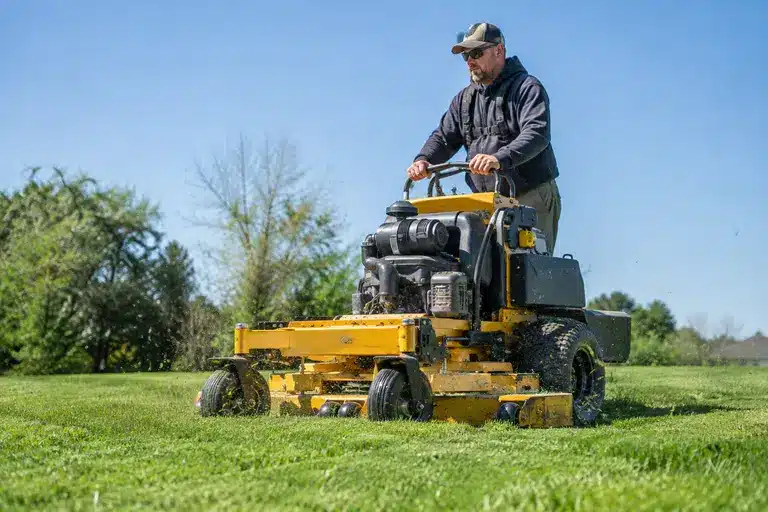
Stand-on platforms were another clear theme. The format is spreading beyond mowing into blowers, aerators, sprayers, snow tools, and other property-care machines. The appeal is easy to understand: operators can see more of the work area, get on and off faster, and maneuver in tighter spaces than some seated machines allow.
That said, stand-on equipment is not automatically the safer or better choice. It can be a poor fit for rough ground, inexperienced operators, cramped storage, or properties with slopes beyond the machine’s rating. For homeowners, a stand-on machine may also be hard to justify unless the property is large and storage space is adequate.
Multi-season accessories also deserve a measured look. RC Mowers showed slope machines with accessories such as sprayers, snow plows, and salt spreaders. STIHL introduced a battery-powered snow thrower with a 22-inch clearing width, 180-degree chute movement, and reported throw distance up to 30 feet. These products point toward machines that work across more of the year, but buyers should check whether winter runtime, battery temperature behavior, and service support match local conditions.
Homeowner And Remodel Planning Implications
Match Outdoor Investments To Property Use
Outdoor power tools often get treated as isolated purchases, but they should fit the property plan. If a homeowner is investing in patios, fencing, drainage, planting beds, or a larger lawn area, maintenance equipment should be part of the same discussion. A larger lawn may justify a stronger mower platform. More hardscape may shift priority toward blowers, snow clearing, or compact storage.
There is also a cost-recovery angle, though it should be handled carefully. Yard equipment itself is not the same as a remodel, and it should not be treated as a guaranteed value boost. Still, a property that is easier to maintain can support better day-to-day use and may help homeowners keep exterior areas in better condition. For readers interested in how outdoor investments tie into broader property considerations, browsing a related home-market perspective might provide useful insights from the same network.
Safety should set firm boundaries. Homeowners should avoid risky tree work, storm cleanup near power lines, steep-slope mowing, major drainage excavation, and any electrical work tied to charging infrastructure. Those jobs call for qualified professionals with the right training, insurance, and equipment.
Cordless Outdoor Power Buying Takeaways
What To Check Before You Buy
The best lesson from Equip Expo is that cordless outdoor power is becoming more capable, but capability must be matched to the job. A strong spec sheet is useful only if the machine can finish the work, recharge within the available window, and be serviced without long delays.
- Check battery compatibility across the tools you actually plan to own.
- Compare real property size, slope, grass conditions, and seasonal tasks against the manufacturer’s stated limits.
- Ask the dealer about replacement battery cost, charger requirements, warranty coverage, and parts support.
- For robotic mowing, evaluate obstacles, pets, children, public access, and signal reliability before purchase.
- For commercial use, test productivity over a full workday rather than judging by peak power claims alone.
The latest cordless outdoor power machines shown around the 2026 event point toward quieter yards, fewer single-purpose engines, and smarter battery planning. The cautious approach is to buy the platform that fits the property and the work pattern, not the one with the loudest launch. For high-risk jobs, especially tree work, steep terrain, electrical charging upgrades, and snow or ice control on difficult sites, hiring a qualified professional remains the safer call.